Provide customized design one-stop service
Nov. 12, 2026
Share:
Selecting a catalyst-coated membrane (CCM) for a PEM water electrolyzer is an interface decision, not simply a membrane-thickness decision. The CCM must fit the cell's active area, contact its porous transport layers (PTLs), and perform under the intended water, pressure, temperature and electrical conditions. This guide gives OEM buyers a practical comparison and sample-request checklist.
A CCM is a proton exchange membrane with a catalyst layer applied to each side. The anode catalyst layer supports oxygen evolution; the cathode layer supports hydrogen evolution. The membrane conducts protons while separating the product gases. For the full cell context, see Gitan's PEM electrolyzer guide.
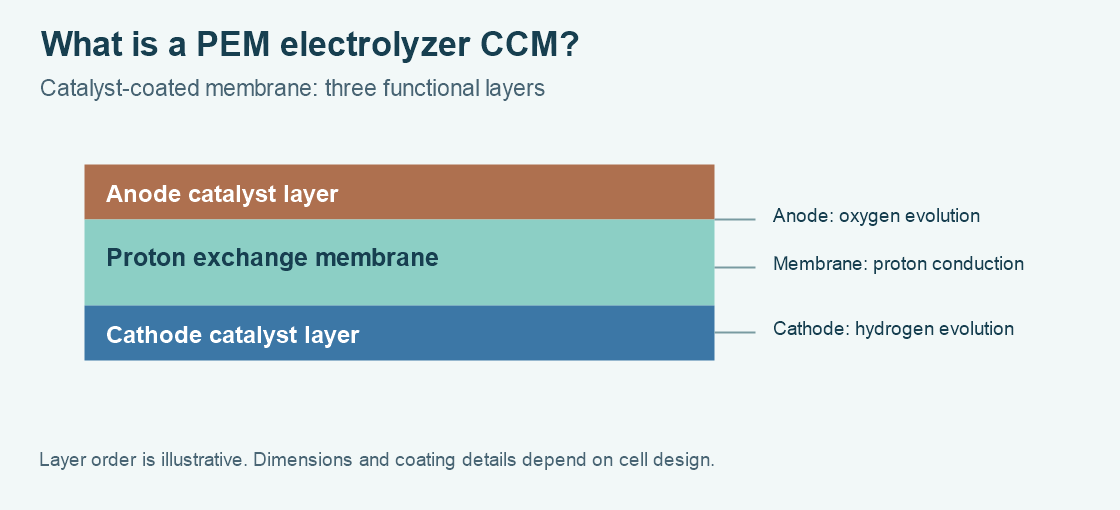
Figure 1. CCM layer schematic. Layer thicknesses and coatings are illustrative, not product specifications.
Terminology varies between suppliers. A CCM usually means the coated membrane itself. A membrane electrode assembly (MEA) may refer to a CCM combined with porous layers or other cell-specific components. When requesting a quotation, list exactly what must arrive: the coated membrane alone, or a larger assembly including PTLs or diffusion layers. Confirm which face is the anode and whether the coated area differs from the membrane outline.
The two sides carry out different reactions. The anode operates in an oxidizing environment and is commonly based on iridium-containing oxygen-evolution catalysts. The cathode commonly uses platinum-containing hydrogen-evolution catalysts. Ask the supplier to identify the material system, the loading basis and the test method for each side. A loading figure by itself cannot establish cell efficiency or durability.
Buyer check: Compare reported performance at the same current density, temperature, pressure, water quality and cell configuration. Ask whether the data comes from a single cell or a stack.
Specify both the active area and a finished outline drawing. They are not interchangeable: the drawing also captures uncoated margins, ports, sealing lands and alignment features. Compare membrane type and thickness together with gas-separation requirements, operating pressure and cell design. Confirm that the anode coating face matches the intended PTL surface and assembly compression.
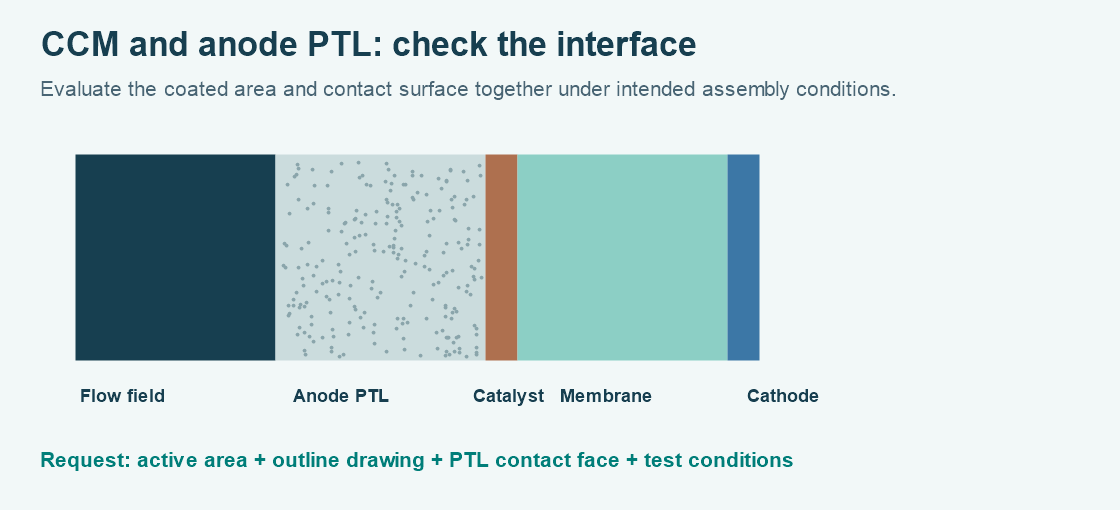
Figure 2. CCM-to-PTL interface schematic. Geometry and dimensions are not to scale. Read the titanium PTL selection guide when comparing the contacting layer.
Request the measurement conditions with every number. A cell-voltage claim, for example, is difficult to compare without current density, temperature, pressure and the test cell's other components.
| Item | Why it matters | Ask the supplier |
|---|---|---|
| Membrane and outline | Fit, sealing and gas separation | What are the membrane type, thickness tolerance, finished dimensions and uncoated margins? |
| Catalyst layers | Reaction activity and material use | What is specified for each side, and how is loading measured and reported? |
| Polarization data | Shows voltage across operating current | Can you provide the curve, cell configuration and operating conditions? |
| Gas crossover | Relevant to purity and operation | How was it measured, at what pressure and current density? |
| Durability | Indicates change under a defined protocol | What were the test duration, duty cycle, water quality and voltage-change metric? |
Send the active area and finished drawing, target operating current density, temperature and pressure, water-quality specification, the anode and cathode PTL materials, assembly conditions, sample quantity and required test documentation. State whether you need a CCM only or a more complete membrane electrode assembly.
We are evaluating a CCM for a PEM water electrolyzer. The active area is [cm2], and the attached drawing shows the membrane outline, coated area and sealing margins. Our intended current density is [A/cm2], temperature [C], pressure [bar] and water specification [standard or analysis]. The anode PTL is [material] and the cathode-side porous layer is [material]. We need [quantity] samples of [CCM only / specified assembly]. Please provide the material description, dimensional tolerances and polarization, crossover and durability test conditions available for this design.
No single thickness determines durability. Assess membrane strength, gas crossover and cell performance under the intended pressure and operating cycle.
No. Compare loading together with cell voltage, crossover and durability under equivalent test conditions and with the same contacting materials where possible.
Do not assume it does. Ask the supplier to state exactly which porous layers, if any, are supplied with the coated membrane.
Explore Gitan's CCM product range or contact the team with your active-area drawing, contacting materials and operating conditions to discuss sample requirements.
Need Custom Design and Development for CCM And PEM Electrolyzers?
We strongly support customer personalisation and customisation, providing the most suitable solutions based on different customer needs. If you have any customisation requirements, please contact us and we will provide you with the most professional advice and products.
View MoreRelated Products
We R&D, design, manufacturing and sales of PEM membrane electrodes, hydrogen and oxygen electrolytic cells and other ancillary products.
The 2400ml 300ml/layer series Single-Output Hydrogen-Oxygen Electrolyzer is composed of 8 layers of 300ml PEM proton exchange membranes stacked together.
200ml/min PEM Electrolyzers for Hydrogen Water - Hydrogen Generation for Water Filtration A200E-2100
The 200ml 100ml/layer series Two-Layer Hydrogen-Oxygen Electrolyzer consists of two layers of 100ml PEM (Proton Exchange Membrane) stacked together.
The 500ml 250ml/layer series Dual-Output Hydrogen-Oxygen Electrolyzer is composed of a stacked combination of dual-layer 200ml PEM proton exchange membrane.
PEM Electrolyzers for Industrial Hydrogen Production and Fuel Cell Applications
The 3000ml 250ml/layer series Dual-Output Hydrogen-Oxygen Electrolyzer is composed of 12 layers of 250ml PEM proton exchange membranes stacked together.
Ion Exchange Membrane Alkaline Water Ionizer J002-9P for Water Dispensers – 9 Plates with Cover
The J002-9P Electrolyzer is designed for high-efficiency hydrogen production with a 9-layer microfiltration membrane and platinum coating. It features adjustable flow and pH, ensuring versatility. The dual-sided coating enhances scale removal, providing stable and reliable output. The compact structure makes it ideal for sustainable hydrogen genera
Compact Three-Button Alkaline Water Electrolysis Module for Dispensers
The Three-Button Electrolyzed Alkaline Water Module is designed for producing purified alkaline water with PH levels of 8.5 and 9.5. Using a flow sensor and TDS monitoring system, this module adjusts the electrolyzer’s power to produce alkaline water at the cathode and acidic water at the anode.
PEM Electrolyzers for Eco-Friendly Hydrogen Supply in Commercial Applications
The 2000ml 200ml/layer series Single-Output Hydrogen-Oxygen Electrolyzer is composed of ten layers of 200ml PEM proton exchange membranes stacked together.
Alkaline Water Module for RO water dispenser
Electrolyzed Alkaline Water Module is designed for producing purified alkaline water with PH levels of PH5.5;PH 8.5; PH9.5 and PH10.5. Using a flow sensor and TDS monitoring system, this module adjusts the electrolyzer’s power to produce alkaline water at the cathode and acidic water at the anode.